We had two lectures in class this Monday. One was on the Voyage & Return storyline in Animation and especially Japanese Animation, and the other was a discussion of Film Criticism.
Voyage and Return
We mostly talked about the narrative where the hero or the protagonist goes (or is forced to) a new world, and have to make it back home. It's used a lot in Anime and Pixar animation, which I thought was interesting. They both consistently have characters get thrown into unfamiliar places, and then have to make it back. I find it interesting that this narrative is more common in Animation than other films, probably because Animation allows you to create fantastical and otherworldly places to put the characters in. The characters get to interact with that world design, and learn something new.
Our lecturer focused on the idea that Narrative often reflects the power fantasies and escapism of the culture in which they're made. So, in Japan, where population density is unbelievable, and a lot of people have trouble getting out of the house and seeing nature, have a lot of media that fantasizes about a simpler time, or a scenario where there are very few players, like Sword Art Online, where they end up in a VR world with only 11 000 people in it. They like to imagine themselves in a world where there aren't many people.
I think that's visible in American and European media too. The Americans, especially now, have a lot of superhero movies in production. I think there's a parallel here with Japanese Anime. While the Japanese want to escape from the reality of everyday life, I think the Americans want to see heroes again. The US has always had a strong obsession with it's historical figures, and also on modern day celebrities. But these days there aren't many heroes to follow, people like Roosevelt, or Eisenhower, or war heroes. so I see the superhero thing as a bit of a fulfilment of that wish to have truly great heroes, heroes that don't really exist these days. This is just an instinct reaction from the discussion, so I'd have to do research to know for sure.
Film Criticism
I won't talk as much here about the lecture, mostly because it's something I've covered a lot already. In my film course from high school, I did a lot of analysis and did a lot of essays on film and film analysis, so most of the words, tactics, and methods of analyzing film were already familiar.
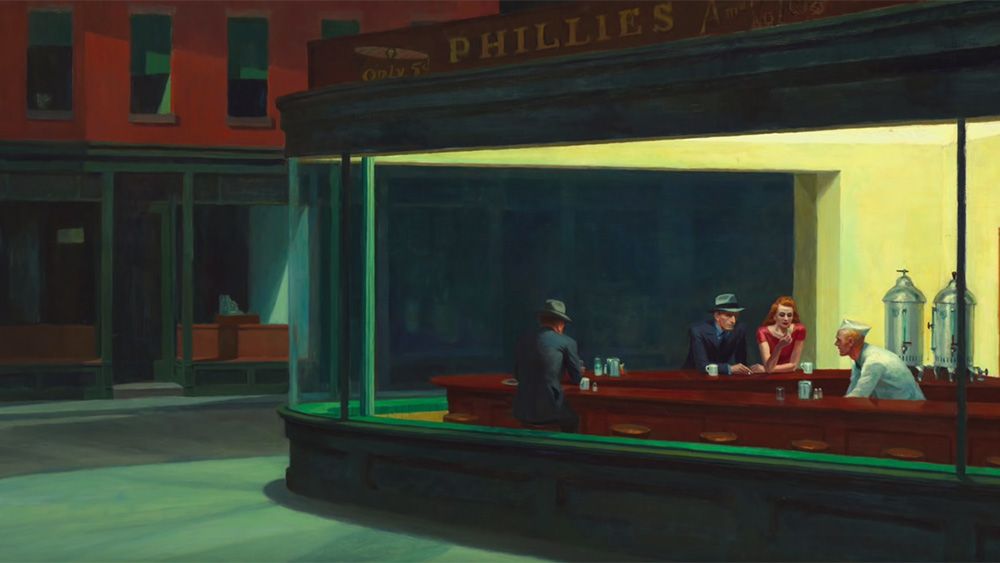
I did find a few interesting things, like the Edward Hopper painting Nighthawks:
I really like this painting, and I could point out a few reasons, like the loneliness, the emptiness of the composition, and the neutral, realist approach to the scene. The thing that I actually want to talk about is how my interpretation of the painting was different from others. I didn't get the sense of the people in the scene being trapped, or stuck, like most people interpreted. I also didn't get the sense that the man in the front was looking at the woman in the red dress, and that that was the focus of the scene. I felt like the setting in the painting is more important, and that while there's a bit of character there, they're pretty much just blank slates (to me). I found it surprising that the painting caused different emotions like that, and I don't really know why.
I didn't get the sense that we really got deep into film analysis in the class. I've always felt like scene analysis is a bit pointless, since the scene has to be put in context with the rest of the movie, and that the overarching plot points are more important. I also don't think the observations made in class were really that enlightening to me. For example, noticing that one character is wearing black, and the other white, creates a conflict and implies one is good and one is bad. I don't know, I just think it's a bit of a dead end, and that fixating on such small details takes away the focus from the film as a whole.
Comments
Post a Comment